
Exploring East Sussex with a car, Ashdown Forest was top of my list for the very obvious reason of visiting the inspiration for A.A. Milne’s Winnie-the-Pooh and the Hundred Acre Wood. Passing lots of children with their favourite Winnie-the-Pooh toys, as well as many adults making the pilgrimage to the home of their beloved childhood characters, Ashdown Forest makes for a great day trip whether you are a fan or not.
History
Ashdown Forest is located in East Sussex in the High Weald Area of Outstanding Natural Beauty and is the largest free public access space in the South East of England. A deer hunting forest in Norman times, there are no signs of deer anymore. Instead, you might see ancient breeds of sheep, cattle and ponies grazing, and rabbits, stoats, weasels, shrews and badgers if you are luckier than I was.
Nearly two thirds of the forest is made up of heathland, a type of landscape found throughout the UK as a result of heavy land usage, despite their wild appearance. Heathlands are made up of plants such as heather, bilberry, gorse and bracken which are suited to growing in infertile and well-draining soils. They are also spectacular places to visit in late summer when the landscape is coloured a vibrant purple.
These largely open spaces with only sparsely placed trees are the result of centuries of modification by humans through grazing and land-clearing. This process began at least 5,000 years ago when humans began clearing trees, possibly to entice game into clearings to make hunting them easier. Following this they were used for livestock grazing, with some areas showing layers of charcoal in the soil that tell of fire being used repeatedly to clear the land for grazing or crops. Almost all heathlands in the UK are thought to date from the Bronze Age, approximately 3,000 years ago.
Low in nutrients to begin with and therefore largely infertile, the nutrient levels declined further and acidity levels rose with grazing and clearing, suiting the plants that now populate these areas that were previously restricted to coasts, cliff tops and mountaintops.
This landscape now relies upon grazing to maintain the ecosystem that has formed over centuries of overuse with many species of insects, lizards and birds becoming dependent upon it. Without continued management, these areas become more wooded and nutrients are gradually added back into the soil. While that sounds like a positive, it would completely change the landscape that so many species have adapted to, as well as being a historically fundamental part of livestock grazing over the centuries and supply of heather for thatch, bracken for bedding, gorse for bread ovens and sand and gravel for building, among many other things. Continual management means ensuring that there are grazing species around, such as the ancient breeds of sheep, ponies and cattle that roam Ashdown Forest.
The only heathlands that are naturally occurring are those that are classed as “montane heath,” which grows at altitudes above 700m where the exposure prevents the growth of taller shrubs or trees. “Maritime heath” is instead found along cliff tops were the strong, salty wind has the same effect, particularly along the Atlantic coast.
Many heathlands have been lost due to their decreased value to economies, agricultural development and planting of conifers, resulting in the loss of many species that had adapted to this specific environment. Conservation efforts have tried to maintain what is left for its wildlife and cultural history and importance.

What you may find in Ashdown Forest if you are lucky is a little yellow bear… Most famous for its association with Winnie-the-Pooh, this forest sees many visitors every year coming to walk through the place that inspired A.A. Milne’s beloved stories, created during his exploration of the forest with his son, Christopher Robin.
A.A. Milne attended Trinity College at the University of Cambridge on a scholarship in mathematics, but began writing for literary magazines Granta and Punch following his graduation in 1903. He served during WWI from 1915, despite being a pacifist, as a Signalling Officer, which meant maintaining communications between the Front Line and more Senior Officers back at Head Quarters. It was during the 1920s that he gained greater success as a novelist, poet and playwright, most notably for When We Were Young and Now We Are Six, his collections of poetry for children, and, of course, his two books of stories about Winnie-the-Pooh and his friends, inspired by his son Christopher Robin and his own set of toys.
Christopher Robin’s toy bear was named Winnie after a Black Bear called Winnipeg the Milne’s encountered while on a visit to London Zoo in the early 1920s while they still lived in London. This bear, Winnipeg, had had quite the adventure in reaching London Zoo in December 1914, having been orphaned in White River, Canada and rescued by Sgt Harry Colebourn. He took the bear with him across to Quebec and then on to England as Colebourn was due to serve on the Frontlines of France. Unable to take Winnipeg any further, he left him at London Zoo where he lived a long life. Colebourn survived the war, but decided to leave Winnipeg in the Zoo where they could take better care of her.
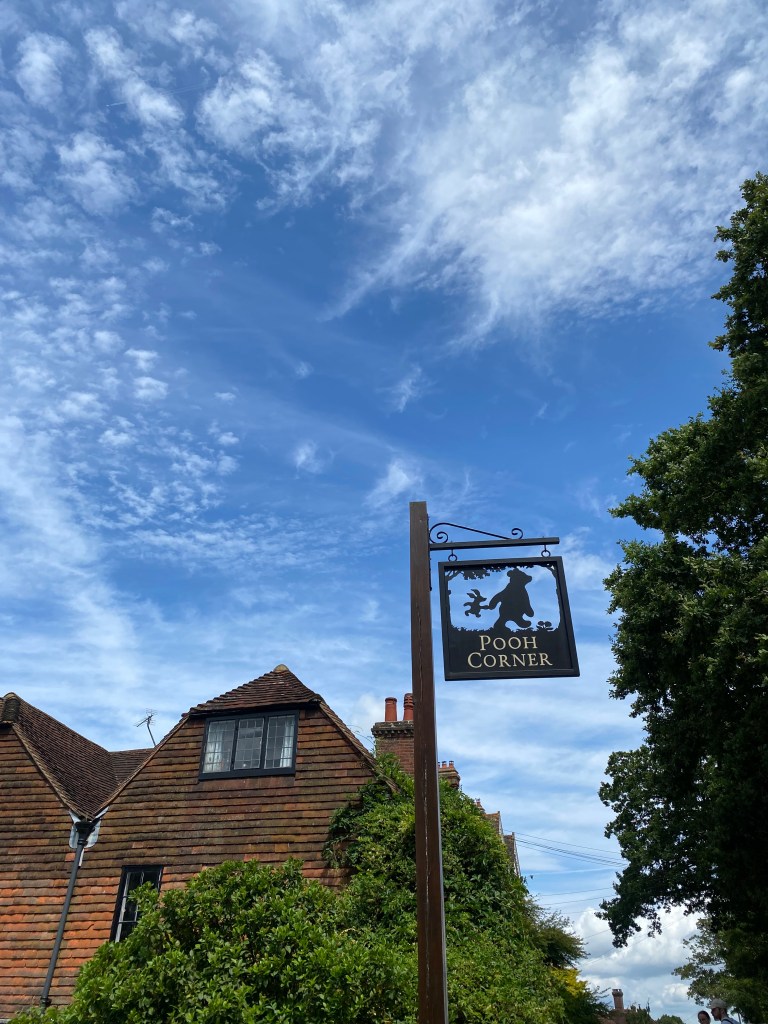
The Milne’s later moved to Hartfield on the edge of Ashdown Forest, which provided the inspiration for the Hundred Acre Wood. You can still stay at their home, Cotchford Farm, as well as visit Pooh Corner, a small house in the village centre that has been converted into a tea room, museum and gift shop, all centred around the beloved characters created by A.A. Milne and further brought to life by illustrator E.H. Shepard.
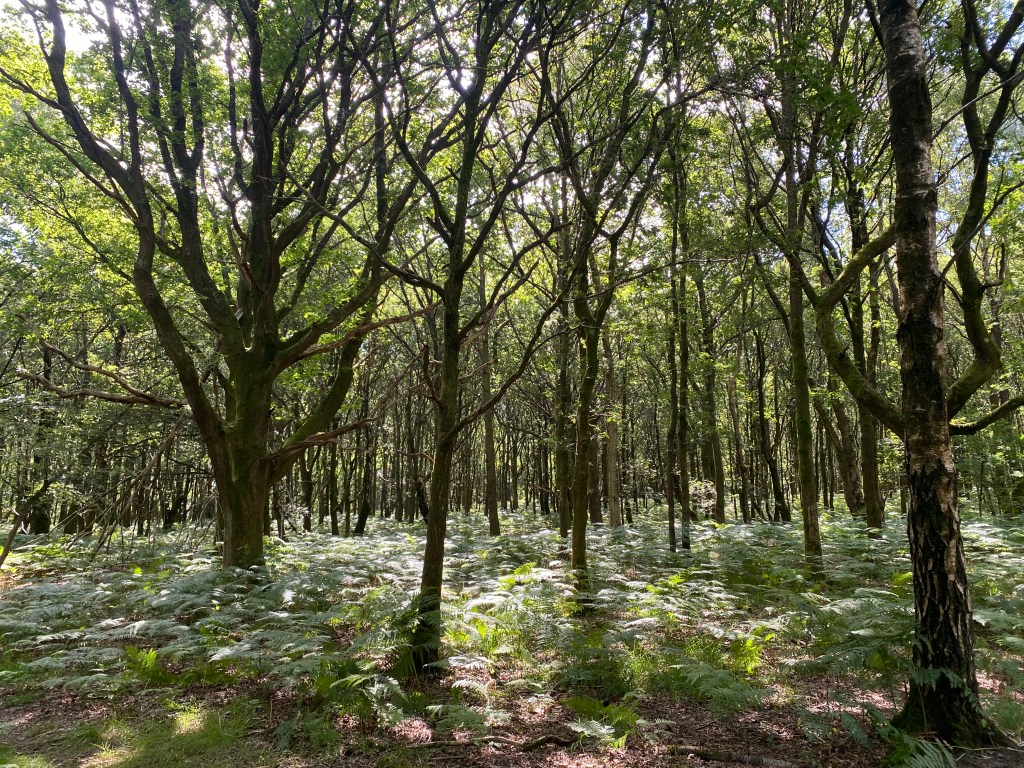
Hike to explore the Hundred Acre Woods
Key Details:

Maps Used:
https://www.alltrails.com/en-gb/explore/trail/england/east-sussex/hartfield-pooh-sticks-bridge-and-withyham
https://www.alltrails.com/ar/trail/england/east-sussex/five-hundred-acre-circular
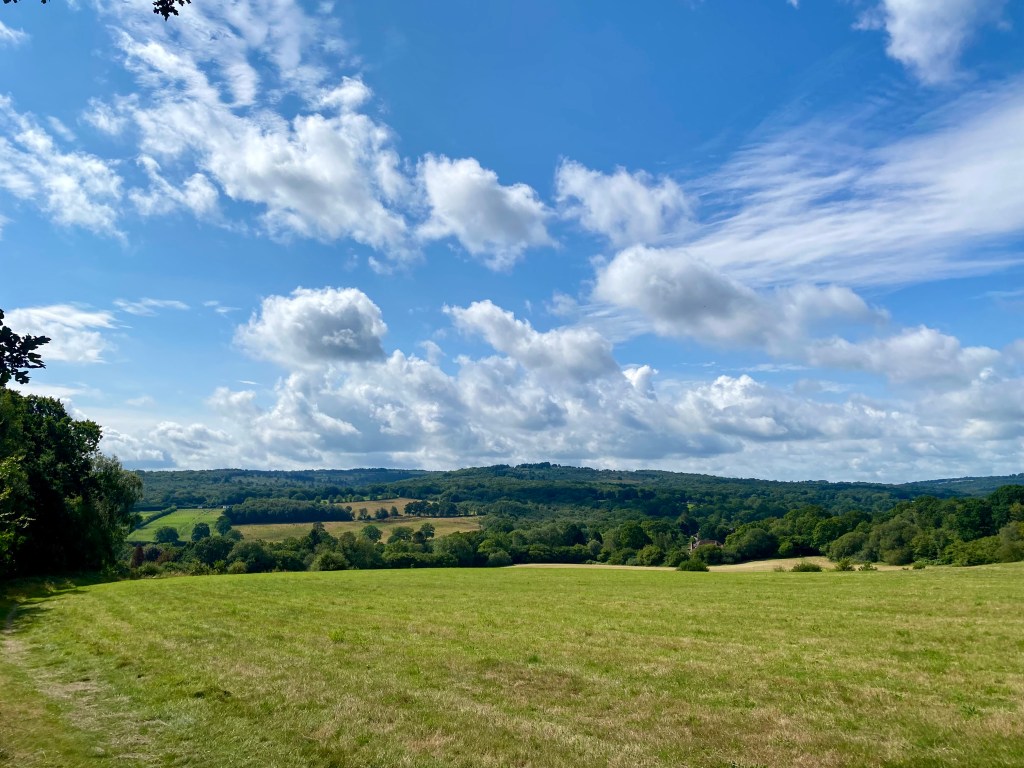
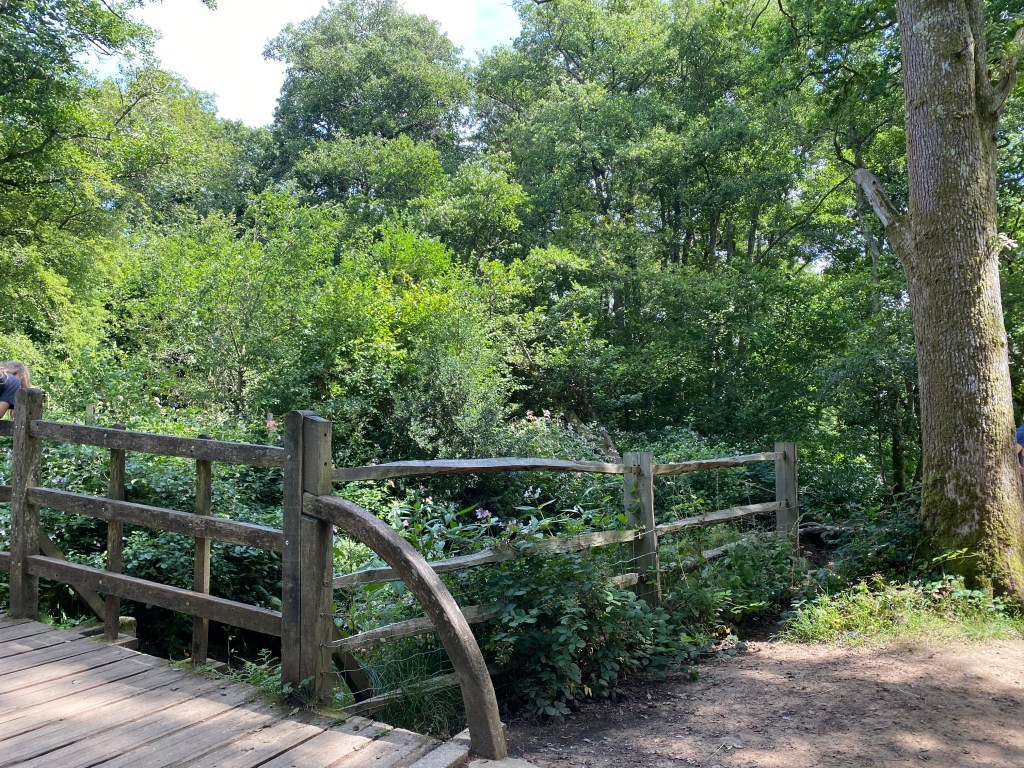
Parking on the High Street of Hartfield, I set off following the first map above (Hartfield, Pooh Sticks Bridge and Withyham), which took me north-west out of Hartfield, skirting farmland, before heading south towards Pooh Bridge. This was an extremely pleasant country walk, passing lovely big houses, crossing fields with views of the forest rising up ahead, and walking along shady woodland trails. I arrived at Pooh Sticks bridge in time to play a quick solo game before it was completely over taken by children of a much more appropriate age!
For those unfamiliar with Pooh Sticks, it is a very simple game invented by Winnie-the-Pooh (or A.A. Milne if we’re being precise) and is listed as Number 19 of the National Trust’s “50 Things to do before you’re 11 3/4.” It involves no more than finding a stick of your choice and dropping it into running water over the side of the bridge, running to the other side of the bridge and waiting to see whose stick reaches the other side first. Ideal for two or more players of any age, my solo game nonetheless brought me plenty of joy (I won).

From here, there are a number of extremely cute houses to find hidden amongst the trees, including Pooh, Piglet and Owl’s houses, which have been recreated from the books. It definitely helped that there were already children admiring the houses as they are appropriately quite small!


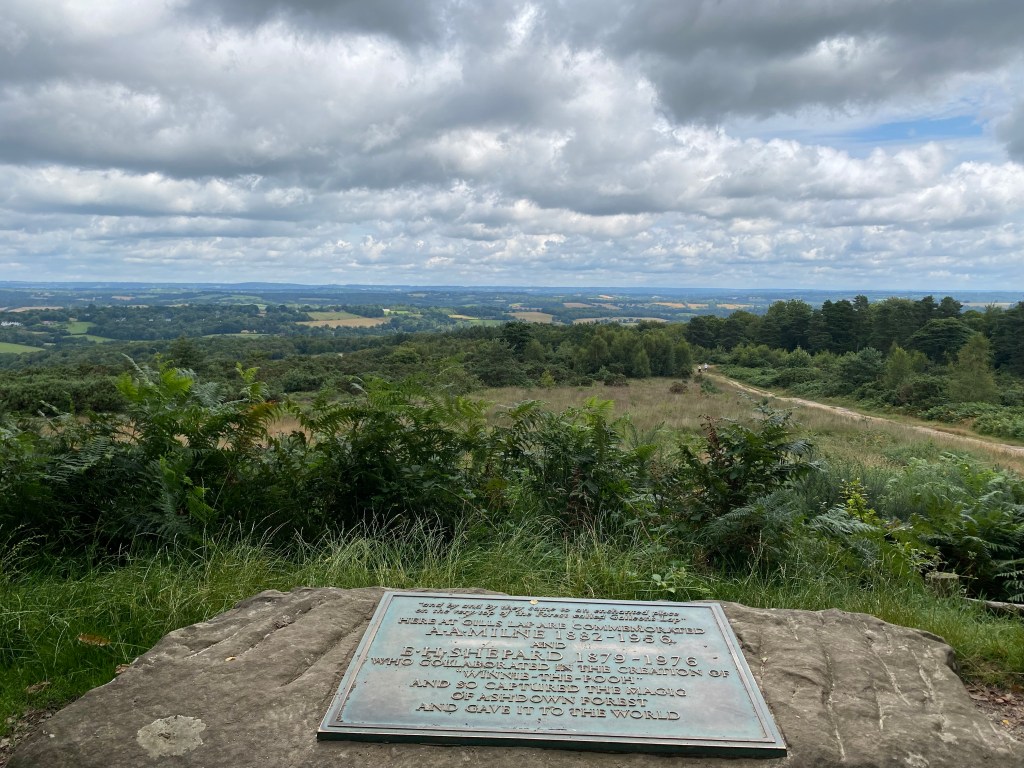
Once past the car park closest to Pooh Sticks Bridge, the trail became a little quieter and much more beautiful and interesting as far as I was concerned. Surrounded by the brilliant purple of heather, dappled sunlight through oak trees and big views as you gain height, this was a beautiful place to walk and I would certainly come regularly if I lived in the area. The highest point has a memorial to A.A. Milne and E.H. Shepard, an appropriately beautiful spot with the best view of the forest below, dedicated to two men who brought the forest to the attention of the wider world, still enjoyed nearly 100 years later.
Also near this spot you can find the lone pine and Heffalump trap branching off to the right, as well as a track leading to the North Pole and Eeyore’s Sad and Gloomy Place off to the left. Heading steeply downwards towards the North Pole provided fantastic views up to the hill ahead where I spotted a group of horses grazing in the distance.


I decided to head back the same way as I had gone way off my original route and didn’t have all day. Arriving back in Hartfield, I had a quick visit to Pooh Corner. While originally planning on stopping here for early afternoon tea, it was so busy I decided just to have a look in the museum before heading off, but there is plenty of seating both in and outdoors if you arrive at a quieter time of day!
Pooh Corner
Key Details:

Located on the High Street of Hartfield, it is hard to miss this gorgeously cute old house with its sign depicting Pooh and Piglet. Inside are a huge array of Winnie-the-Pooh related gifts, as well as a museum dedicated to the life of A.A. Milne and the history of these world-famous books. There is also a tea room, all appropriately themed of course!
With so much to explore for fans of the famous bear, and reluctant fans, Ashdown Forest is well-worth a visit.
Sources
https://www.woodlandtrust.org.uk/visiting-woods/woods/ashdown-forest/
https://www.woodlandtrust.org.uk/trees-woods-and-wildlife/habitats/heathland-and-moorland/
https://www.wildlifetrusts.org/habitats/heathland-and-moorland
https://ashdownforest.org/explore/winnie-the-pooh/
https://www.biography.com/authors-writers/aa-milne
https://poohcorner.co.uk/winniethepooh/
https://www.nationaltrust.org.uk/visit/50-things/no.-19-play-pooh-sticks




 Xanthe Explores
Leave a reply to Road trip around the South East of Dorset – Xanthe Explores Cancel reply