
Now a National Trust property attracting large numbers of visitors each year with a beautiful gift shop, gardens and cafe, Bateman’s was once the peaceful countryside retreat of Rudyard Kipling, famed author and Nobel Prize laureate. Hiring a car for a long weekend to get to some of the spots in East Sussex that are harder to reach via public transport, Bateman’s was high on my list and did not disappoint. Knowing little about Rudyard Kipling on arrival apart from the fact he wrote The Jungle Book, I left with a better grasp of his life and was keen to learn more, as well as falling in love with his gorgeous home.
Key Details:

History
Built in 1634, this Jacobean mansion, with beautiful oak beams and panelling on the inside and an exterior made of local sandstone, feels like a wonderful place to call home and it is clear why Rudyard and Caroline Kipling bought the house and its surrounding 33 acres in 1902. Having reached his later 30s and amassed a substantial fortune through the international success of books such as The Jungle Book, Kipling and his wife were keen to find somewhere that offered privacy as well as the beauty and sense of history that Bateman’s pervades.
Rudyard Kipling was born in India in 1865 to John Lockwood Kipling and Alice Macdonald. His father was an artist and scholar who had moved to India with his new wife when he took up the position of principal at a School of Art in the attempt to “encourage, support and restore native Indian art against the incursions of British business interests.” Kipling therefore spent his first six years of life in India, in what he described as a kind of paradise. This did not last, as he was sent to England for his education, a time he did not describe so warmly.
He returned to India after his schooling to work as a journalist as his family was unable to fund a university education, writing fiction and poetry in his spare time. Garnering success in England, he moved to London six years later where he met and married his American wife, Caroline Balestier. Moving to live in America with her, it was there that Kipling wrote The Jungle Book and both his daughters were born.
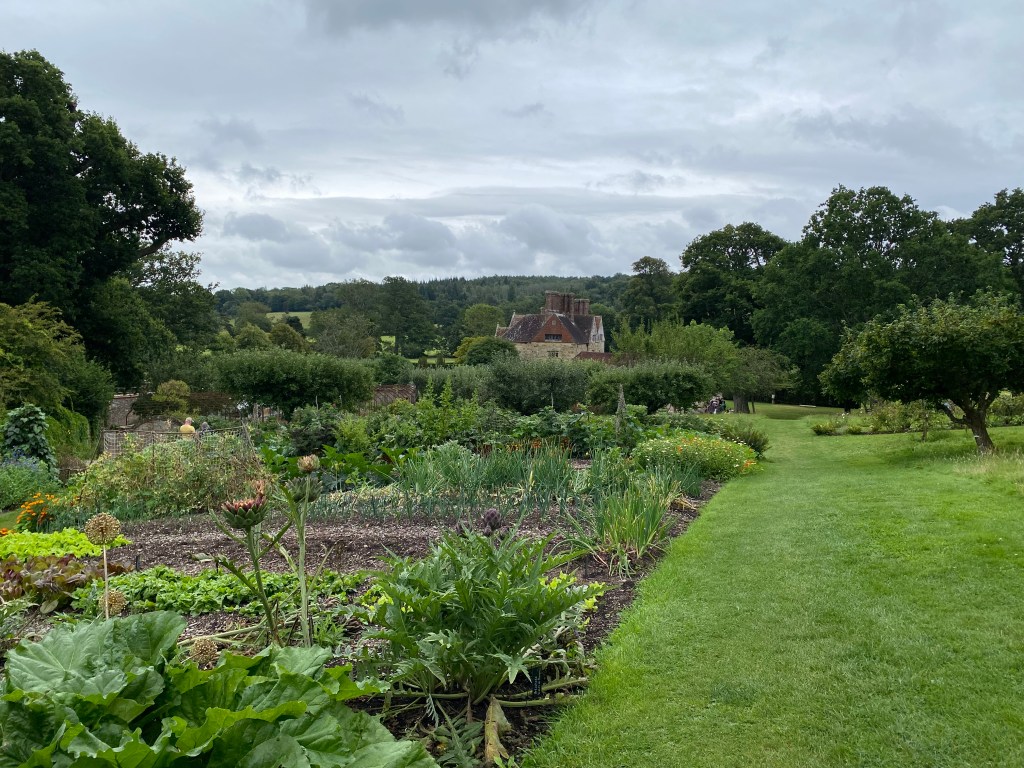
After an argument with his in-laws, the Kiplings returned to England to live in Sussex near his own family. They had never adjusted to life in America, and Kipling refused to be interviewed which made him very unpopular with the American press. They eventually purchased Bateman’s in 1902. Kipling himself added much to the garden, including an orchard, yew hedges and a kitchen garden, as well as designing the rose garden. This became the playground for his two surviving children, Elsie and John, to grow up in and the garden and surrounding countryside inspired much of his writing. It was here that he wrote one of his most famous works, Just So Stories.
Receiving the Nobel Prize for Literature in 1907, he became the first English person to do so. Much celebrated for his significant output and achievements to the literary field, he also served as a war correspondent during the Boer War and was the “Honorary Literary Advisor” to the Imperial War Graves Commission from 1917, the same year his son was confirmed dead after being missing in action for the past two years. He selected the phrase, “Their Name Liveth For Evermore,” which is seen on many British war memorials. Kipling also had some very controversial views, particularly on the subject of colonialism, even for the time.
One misconception is that he was a supporter of the Nazi regime as his books were frequently adorned with swastikas, forming decorative borders and as part of illustrations. This was put to an end by Kipling once the Nazis took up the swastika as their own. It was instead used as the Hindu good luck symbol, coming from his father’s substantial knowledge of Indian art. The symbol has been used for centuries, meaning “fortunate” or “well-being” in Sanskrit. It was also used as a potter’s stamp in Neolithic Europe, a mason’s mark in Minoan Crete, and has been seen in Homeric Troy and early Indian civilisations. Hindu traders start their annual accounts with a swastika for good luck, and migration of Buddhists saw the spread of the symbol into China and Japan, and later through West Africa and America. It was also often used in early Christian art to fill in spaces of stained-glass.
Rudyard and Caroline had three children, only one of whom survived them. Their first child, Josephine, died at the age of six from pneumonia just after their arrival in America, while John, their youngest, died during the Battle of Loos in WWI. Elsie, their surviving child, bought Wimpole Hall just outside of Cambridge, so Bateman’s was left to the National Trust by Caroline following Rudyard’s death in 1936 and her own in 1939.

House and Gardens
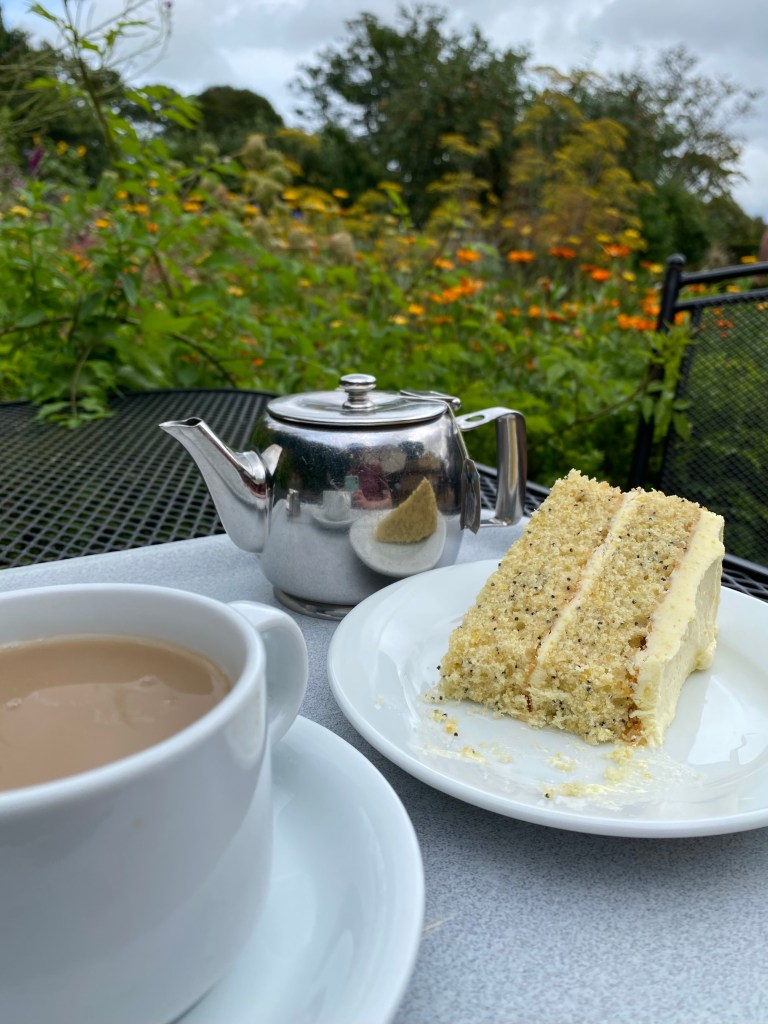
Arriving after a morning hike and lunch, I was keen to start with some tea and cake in the garden before venturing into the house. A delicious slice of orange and poppyseed cake later, I wandered around the beautiful garden beds filled with bright flowers and fruiting trees on my way to the house.
Entering the house is like stepping back in time; cosy, warm and comfortable despite dating back to the 17th century, Bateman’s certainly feels like a home that has been loved. Still filled with the Kipling’s possessions, it feels as though they may have just stepped out, albeit leaving behind a whole lot of guests!
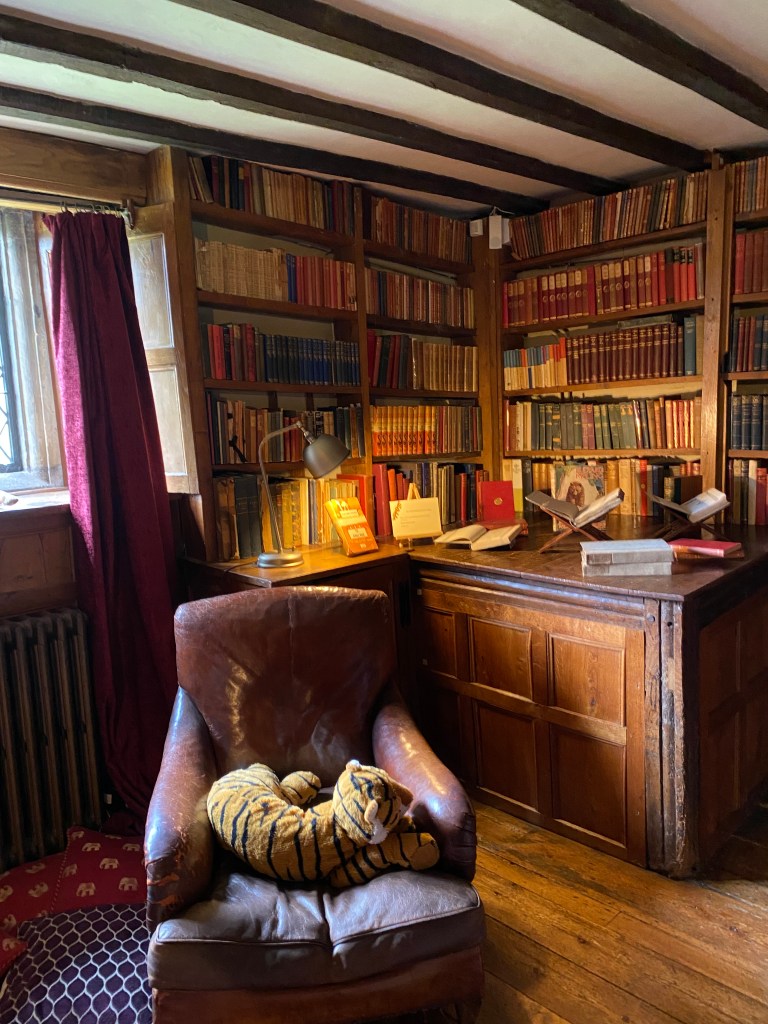
After the entrance hall, there is a small mezzanine level that was Caroline’s office and is now filled with various editions of The Jungle Book and related memorabilia. It is exactly the kind of reading room I would love in my own house; lined with dark timber book shelves overflowing with books, good natural lighting, and a low ceiling with exposed beams giving a warm and cosy feel.
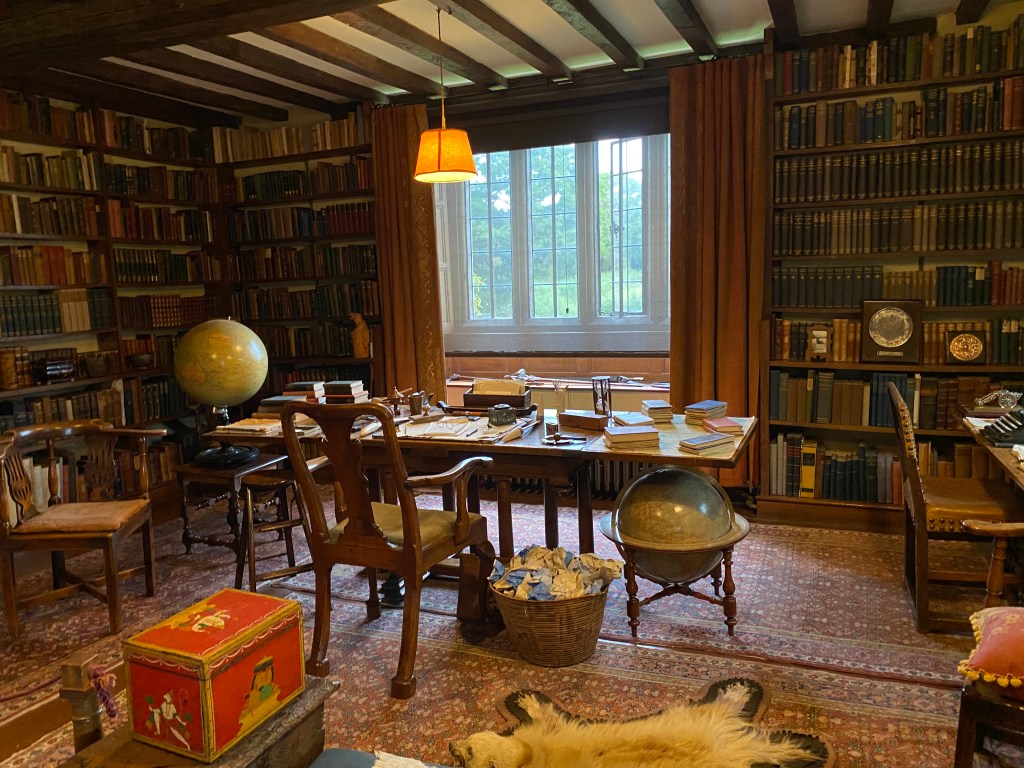
Upstairs is the study that Rudyard Kipling wrote in, giving you a better feel of who he was. Enormous bookshelves line the walls, filled with all manner of subject matter from poetry to bee-keeping. As the room guide said to me, this was his Google! Centre place is taken by his huge wooden desk, apparently not quite as messy as when it was in use. The bin is overflowing with scrunched up paper; supposedly he would burn his scribbles on a regular basis as people would pay all sorts to have a sheet of paper with his handwriting on it.
Next door houses a collection of artefacts relating to his life including his Nobel Prize. It was interesting to be able to see this in person, as it’s not everyday you are this close to a Nobel Prize of any kind! Off to the side of this room is a framed watercolour from one of the early editions of The Jungle Book, illustrated by twin brothers, Charles Maurice and Edward Julius Detmold. Very different to the Disney Jungle Book of my childhood, these are much more “adult” illustrations, more realistic, dark and gritty while still beautiful and full of imagination. The watercolour on display is of buffalos, and there are also official postcards from 1908 with a selection of the illustrations on them.
The Detmold twins were orphaned at a young age and subsequently adopted by their uncle. He regularly took them to London Zoo where they would draw the animals housed there, improving their significant talents over time. Kipling was made aware of the twins and commissioned them to illustrate The Jungle Book while they were still teenagers. Sadly, Charles Maurice committed suicide at the age of 24, while Edward Julius did the same 50 years later.
Back downstairs, the dining room was another highlight of the house, lined with stunning embossed leather wall hangings, acquired by the Kiplings from a property on the Isle of Wight. With its origins in North Africa, embossed wall hangings were introduced to Spain from around the 9th century, remaining popular there until the 17th century. From Spain, the technique and fashion spread to the Low Countries in the 15th or 16th century, where the skills involved were further refined in places such as Antwerp, Brussels, Ghent and, most significantly, Mechelen. This slowly fell from fashion with the advent of printed wall paper and chintz wall hangings, but they continued to be used in very luxurious homes.
Embossed leather wall hangings such as Cuir de Cordoba, like that in Bateman’s, are typically made using calf skins. While wet, the leather is shaped into the desired pattern using wooden moulds, then painted, oil-gilded and lacquered.

Back outside, I had a quick look through the second-hand bookshop and gift shop, then headed back into the gardens to explore some more. Behind the house is a rose garden designed by Kipling and a large pond filled with waterlilies. Further on the garden turns more wild, including a wildflower meadow, shady paths along the water and a mill that used to power hydroelectric turbines that generated electricity for the house in Kipling’s time.
If time permits and you are so inclined, there are a number of longer walks you can take around the surrounding countryside, detailed in the maps handed out on arrival at Bateman’s, ranging from an hour to an hour and a half. One of these takes you into the gorgeous nearby village of Burwash. While a much quieter High Street than it would have been in Kipling’s time, it is still lined with beautiful houses and contains a war memorial topped with a lantern that is still lit on the anniversary of each of the deaths, including that of John Kipling.
Bateman’s is well-worth a visit if driving through East Sussex, particularly if the weather is kind to make the most of the beautiful gardens.

Sources
https://www.bbc.co.uk/history/historic_figures/kipling_rudyard.shtml
https://www.kiplingsociety.co.uk/facts_swastika.htm
https://www.poetryfoundation.org/poets/rudyard-kipling
https://www.newyorker.com/magazine/2019/07/08/rudyard-kipling-in-america
https://www.britannica.com/biography/Rudyard-Kipling
https://www.nationaltrust.org.uk/visit/sussex/batemans/visiting-the-house-at-batemans
https://en.wikipedia.org/wiki/Leather_wallpaper
https://burwashparish.org.uk/visiting/history
https://www.nationaltrust.org.uk/visit/sussex/batemans/visiting-the-garden-at-batemans
https://www.nationaltrust.org.uk/visit/sussex/batemans/history-of-batemans




 Xanthe Explores
Leave a comment